Author: Dmitry Troitsky

  • 15 февраля 2026

    Piano Practice · Дневник занятий · Заметки на полях · Архив

    Сегодня день без инструмента.

    Сделал около 50 минут ментальной практики — с нотами и с записью.

    Пробовал выучить окончание.

    Также вспомнил первые несколько тактов — те самые, с которых вообще начинал эту прелюдию.

    Интересное наблюдение: чем сложнее фактура и чем труднее ее по-настоящему «спеть», тем сложнее с ней работать ментально.

    То есть ментальная практика сразу вскрывает: где есть реальное понимание, а где только «пальцы помнят».

    Piano Practice · Дневник занятий · Заметки на полях · Архив

  • 15 February 2026

    Piano Practice · Practice Journal · Marginal Notes · Archive

    Today I was away from the piano. I did about 50 minutes of mental practice, both with the score and with recordings. I tried to memorize the ending. I also recalled the first couple of bars — the ones I started with when I began working on this prelude. The more complex the texture — and the harder it is to truly sing it — the harder it becomes to work with it through mental practice. In other words, mental practice immediately reveals where there is real understanding and where only the fingers remember.

    Piano Practice · Practice Journal · Marginal Notes · Archive

  • 13 февраля 2026

    Piano Practice · Дневник занятий · Заметки на полях · Архив

    Я наконец заставил себя это сделать.

    Целый день был в машине (не за рулем), так что отговорок не было.

    Я и раньше пробовал заниматься ментально, но почему-то через 2–3 такта мозг просто «вставал» — как будто перегружался — и дальше двигаться было невозможно. Такое ощущение, будто происходит внутренний сбой.

    В итоге я признал:

    ментальная практика неизбежна

    и хватит уже лениться

    Сделал три сессии по 20 минут во время поездки.

    Хорошая новость — я очень четко слышу звук в голове.

    Добавил еще и визуализацию рук на клавиатуре — причем сразу с двух ракурсов:

    сверху

    и немного сбоку, снизу

    Это сильно помогает, потому что видно:

    клавиши

    аппликатуру

    и, что особенно важно, можно «добавить» технику

    Я прямо мысленно прокручивал:

    ротацию

    двойную ротацию

    скачки

    любые нужные движения

    И проходил куски с этим ощущением.

    Даже небольшое движение пальцами в реальности помогает подключить мышечное ощущение.

    Самое сложное — удержание деталей.

    Некоторые места все равно «расплываются», и приходится возвращаться к нотам, чтобы проверить.

    Особенно сложно там, где:

    почти одинаковые пассажи с маленькими отличиями

    или когда запоминаешь через гармонию, а потом забываешь, какая именно версия была

    То есть основная проблема — это:

    encoding и retrieval

    Но одно стало абсолютно очевидно:

    решать эти задачи в голове гораздо эффективнее, чем за инструментом

    Руки не устают от бессмысленных повторов,

    а мозг вынужден реально понимать, что происходит.

    Piano Practice · Дневник занятий · Заметки на полях · Архив
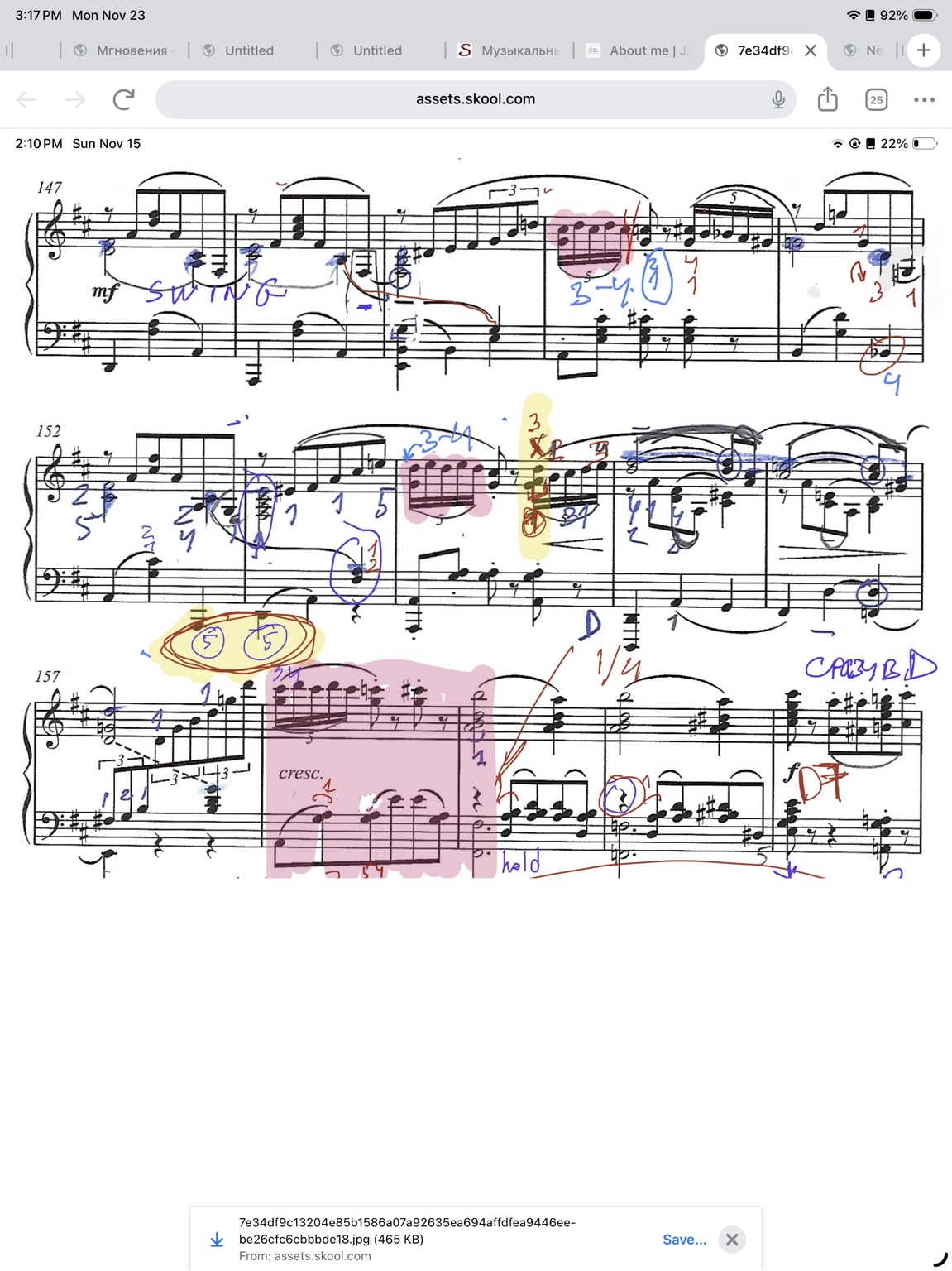
  • 13 February 2026

    Piano Practice · Practice Journal · Marginal Notes · Archive

    I finally made myself do it. I was in the car all day (not driving), so I really had no excuse. I had tried mental practice before, but for some reason after two or three bars my brain would just stall — like it was overloaded — and I couldn’t push forward. It felt like a kind of mental shutdown. So I finally accepted that mental practice is unavoidable, and I have to stop being lazy about it. I did three 20-minute sessions during the journey. The good news is that I hear the sound very clearly in my head. I also added a visual image of my hands on the keyboard — actually from two angles: from above, and slightly from below and the side. That visualization helps a lot, because you can see the keys, the fingering, and — what I especially liked — you can even add rotation, double rotation, proper leaps, any technical element, and run the passage mentally with that physical awareness. A slight movement of the fingers also helps to feel it on a muscular level. The difficult part is that some places are still hard to retain, and I have to look back at the score to check. Especially when passages are almost identical but have small differences — remembering which detail belongs where is tricky. Or when I memorize through harmony, but later forget exactly which harmonic version I had encoded. So the main difficulty is really about encoding and retrieval. But one thing is absolutely clear: solving these problems in the head is much more efficient than doing it at the instrument. The hands don’t get overloaded or tired from mindless repetition — and the brain is forced to actually understand.

    Piano Practice · Practice Journal · Marginal Notes · Archive

  • В плену виртуозной фактуры

    В плену виртуозной фактуры

    Piano Practice · Дневник занятий · Заметки на полях · Архив

    Заметки на полях · EN / RU

    12 февраля 2026

    Честно говоря, начинаю понимать, что самое сложное в си-бемоль мажорной прелюдии Рахманинова (op. 23 № 2) — не техника.

    Самое сложное — сыграть её музыкально.

    Очень напоминает в этом смысле Революционный этюд Шопена: там столько виртуозной фактуры, что легко стать её заложником и превратить всё в такой гремящий коктейль из Черни и Ганона.

    Но со мной этого не случится. 🙂

    Буду держаться за баховскую полифонию.

    Piano Practice · Дневник занятий · Заметки на полях · Архив

  • Held Captive by Virtuosity

    Held Captive by Virtuosity

    Piano Practice · Practice Journal · Marginal Notes · Archive

    Marginal Notes · EN / RU

    12 February 2026

    Honestly, I’m beginning to realise that the hardest thing about Rachmaninoff’s Prelude in B-flat major (Op. 23 No. 2) isn’t the technique.

    The hardest thing is to play it musically.

    In that sense, it reminds me very much of Chopin’s Revolutionary Étude: there’s so much virtuosic texture that it’s easy to become its prisoner and turn the whole thing into a thunderous mix of Czerny and Hanon.

    But I won’t let that happen to me. 🙂

    I’ll hold on to Bach’s polyphony.

    Piano Practice · Practice Journal · Marginal Notes · Archive

  • 12 февраля 2026

    Piano Practice · Дневник занятий · Заметки на полях · Архив

    Сегодня занимался один час.

    Работал над теми же местами, что и вчера, но заходил на них с разных сторон. Использовал метроном и разные подходы, чтобы подтянуть конкретные сложные участки к темпу. Продолжаю процесс запоминания.

    Не удержался и вернулся к тактам 28–29 — самому первому батчу, который «отлежался» уже четыре дня.

    И был очень рад: наконец смог сыграть их так, что начал реально слышать, как это звучит, понимать мелодический смысл и постепенно привыкать к полиритмии.

    Удалось сыграть отдельные фрагменты фразы, пока еще не полностью связно, но ощущение очень хорошее.

    И главное наблюдение:

    пауза не ухудшила — а наоборот, улучшила

    Честно говоря, начинаю понимать, что самое сложное в этой прелюдии — не техника.

    самое сложное — сыграть ее музыкально

    Очень напоминает в этом смысле Революционный этюд Шопена:

    там столько виртуозной фактуры, что легко стать ее заложником

    и превратить все в такой гремящий коктейль из Черни и Ганона.

    Но со мной этого не случится 🙂

    буду держаться за баховскую полифонию

    Piano Practice · Дневник занятий · Заметки на полях · Архив

  • 12 February 2026

    Piano Practice · Practice Journal · Marginal Notes · Archive

    One hour of practice. I worked on the same passages as yesterday, but approached them from different angles. Used the metronome and applied various techniques to get specific difficult spots up to tempo. Continued memorizing. I couldn’t resist my curiosity and went back to bars 28–29 — from the very first batch — which had been resting for four days. I was really happy to finally play them in a way where I could actually hear how they sound and understand the melodic meaning, and get used to the polyrhythm. I managed to play separate parts of the phrase, though not yet fully connected. But it really feels like the rest didn’t make it worse — actually, it made it better. Honestly, the hardest thing about this prelude won’t be the technique — it will be playing it musically. Actually reminds me very much the problematic of Chopin ‘s Revolutionary Etude. There’s so much virtuosic texture that it’s easy to become its prisoner and turn everything into some kind of thunderous mix of Czerny and Hanon. But that won’t happen to me — I’ll hold on to Bach-like polyphony!

    Piano Practice · Practice Journal · Marginal Notes · Archive