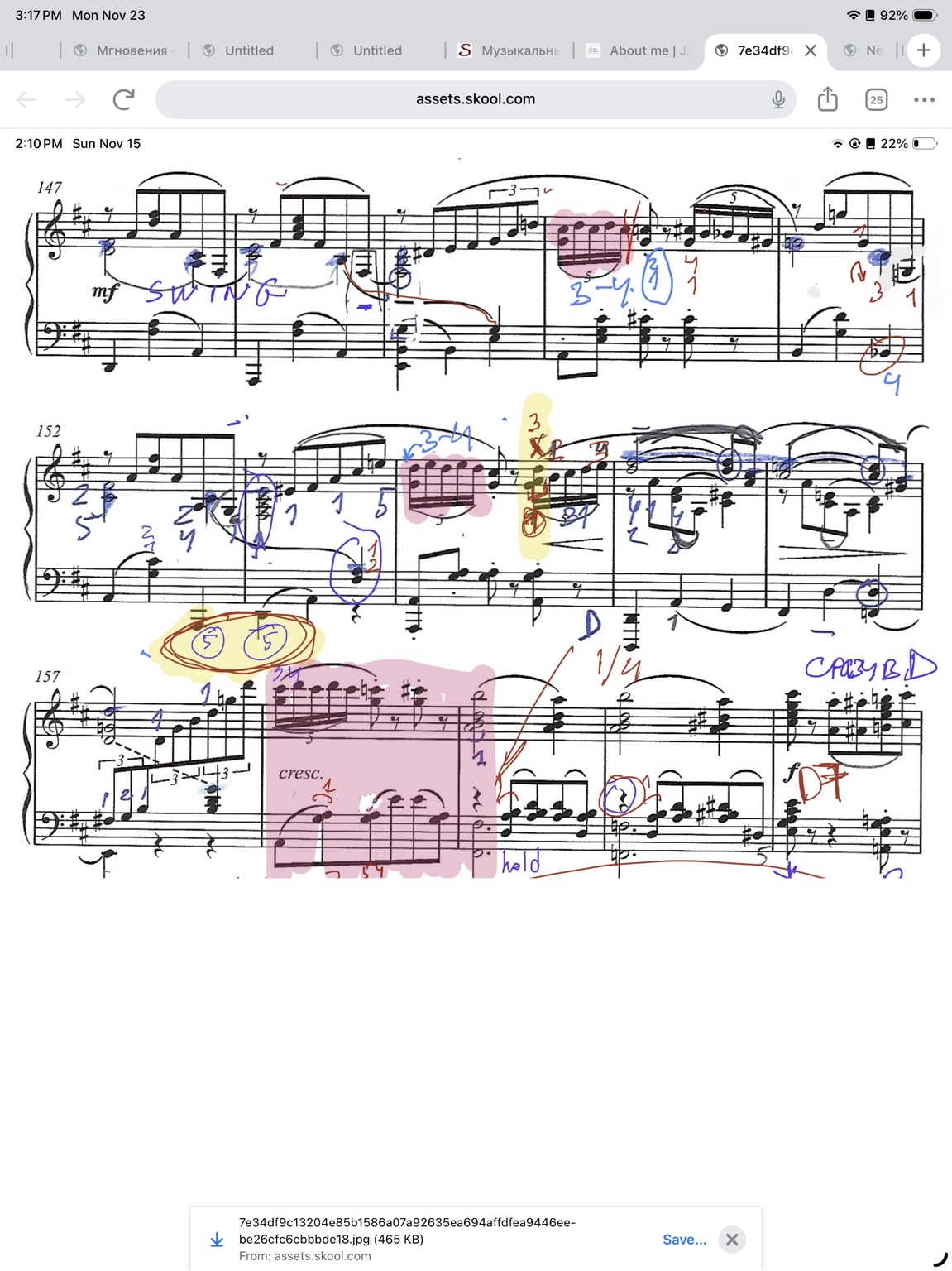
I restarted my piano practice about two years ago, and initially, for let’s say a year and a half, the progress was impressive. I played quite hard pieces, and some I played quite well.
But over the last few months, it has all slowed down.
I’m finding it harder to learn, I’m stuck on the same pieces, and even my memorising has slowed down.
I practise the same amount of time daily — about three hours — but it’s harder even to learn the right notes. The pieces are not harder; some of them are even easier.
I feel I’m wasting precious time and not moving forward. I feel guilty that I don’t practise enough, or properly, or smartly.
If I ever write my memoirs, I think this episode would fit there quite nicely.
I studied music a little as a child. My parents sent me to a music school when I was in the second grade of a Soviet school, so I was about eight years old. I studied there for several years. Strangely enough, what I remember most are the solfège classes, singing in the choir, the director of the school who once called me “Little Richter,” and how terribly nervous I was before performances. I don’t think those performances were particularly successful.
After a few years, for some reason, my mother decided to find me a private piano teacher. Her name was Marina Viktorovna. She worked as an accompanist at the Gnessin Institute in Moscow, one of Russia’s major music schools. We studied together for at least two or three years. I remember playing Mozart, Schumann, Grieg, and Tchaikovsky with her.
Then, when I was about fifteen or sixteen, I needed to learn some Shostakovich theatre music for a performance, so I went back to her. I remember she played Rachmaninoff’s C-sharp minor Prelude for me, and I completely fell in love with it. I decided I had to learn it, no matter what. And I think I actually did. So there was another period, when I was around eighteen or twenty, when I was studying piano again.
Then came a very long break.
In the early 2000s, life arranged something completely unexpected. I met David Helfgott — yes, the Australian pianist whose life inspired the film Shine — and his family. I visited them several times in Australia, and we stayed friends for many years. Well… “friends” is probably not quite the right word, because David is genuinely crazy in the most wonderful sense of the word. I also heard him perform several times in Europe.
Then, in 2023, I attended one of his concerts in Wiesbaden, where he played his signature Rachmaninoff Third Concerto on two pianos. After the concert I came back to Berlin and started listening to recordings, trying to understand how David’s interpretation of Rachmaninoff differs from everyone else’s.
Then I opened the score.
Then I tried to play a little from the Third Concerto myself.
Of course, I couldn’t.
And then, quite suddenly, I realized that I had to start studying piano again.
Once again, fate was incredibly kind to me.
I met a truly unique teacher — one of the great representatives of the great Russian piano tradition, someone who doesn’t simply teach technique but opens your ears, your imagination, and your understanding of music.
Mikhail Arkadiev spent ten years performing with the great Russian baritone Dmitri Hvorostovsky, who sadly passed away. Together they appeared on literally all of the world’s greatest concert stages — and that’s not an exaggeration. Their repertoire was enormous, spanning centuries of music, and they also introduced audiences around the world to the extraordinary vocal music of Georgy Sviridov, which had been almost unknown outside Russia.
I was unbelievably lucky.
I honestly can’t explain it any other way than providence.
To have people like David Helfgott and Mikhail Arkadiev in front of me, to spend time with them and learn from them… that’s the kind of opportunity you simply cannot turn down. In fact, it’s impossible.
So I’m incredibly happy that I came back to the piano.
Now I just try not to be lazy… and to practice as much as my time and energy allow.
Some of my most wonderful childhood memories are connected with the piano: attending a music studio from the age of eight, followed by private lessons at home, hearing Rachmaninoff’s famous bell-like Prelude in C-sharp minor for the first time in my youth, and wanting to play it no matter what.
But the years of perestroika and the emergence of capitalism in Russia redirected my plans towards more pragmatic pursuits. Producing entertainment television at STS and TNT, developing the first reality shows and comedy series, occupied my attention for many years.
Eventually, the desire for personal artistic expression reasserted itself, initially taking the form of several successful photography exhibitions in Miami and Berlin.
And three years ago, I suddenly found myself regretting, for the first time, that I had never learned to play the piano well enough to express everything I could hear within myself.
I felt a powerful desire to return to that wonderful childhood and resume a flight that had once been interrupted.
Then something miraculous happened: I met a teacher who believed in me and supported that aspiration.
Mikhail Arkadiev — an Honoured Artist of Russia, pianist, conductor, composer and philosopher, and Dmitri Hvorostovsky’s regular piano partner for ten years. I was right in sensing that this man knew everything about music and could help me find my way along this path.
The music of past centuries that I play today is my way of sharing thoughts, feelings and emotions through the language of beloved works created by great composers.
This recital is a return to a conversation with music that was once interrupted.
Recital Programme
Johann Sebastian Bach
Toccata in E minor, BWV 914
Franz Liszt
Consolations No. 3 in D-flat major No. 6 in E major
Robert Schumann
Aufschwung (Soaring), Op. 12 No. 2 from Fantasiestücke
For those who didn’t go through a formal conservatory/music school system, this is a real challenge.
In conservatories/music schools, much is absorbed through an established system — through tradition, structure, and trust.
For people like me, building a “home conservatory,” it’s different.
We hear countless opinions and pieces of advice — often contradictory — and it can be confusing.
But in reality, all teachers are talking about the same things — just from different angles, in different language, and in different order.
This is where Rebecca Bogart approach becomes powerful.
She managed to systematize methodology and bring it down to a practical level — into a structured self-guided practice format.
For me, following this structured approach helped organize my process and forced me to accept the necessity of stages I used to ignore, postpone, or underestimate.
(For example, I used to look down on the metronome. Now I see the cost of that.)
What you ignore always comes back and shows up in the result.
This approach gave me a mindset that I now apply to concert preparation.
The simple conclusion:
If you follow a clear methodology consistently, success becomes inevitable.
But it requires discipline.
Practising vs performing — different sports (not a new idea, but more convincing for me now)
Playing for yourself and playing for others are completely different.
A run-through alone is training.
A run-through for people is competition.
To perform well, you need to perform regularly. And good news – ‘fake it until you make it’ principle works here as well.
Repertoire strategy
You want to play everything — but you can’t.
Time is limited, precious and should be used in a most effective way (see pt.1)
Some pieces take vastly more time than others.
Also — simpler pieces played well can be just as powerful as complex ones.
I will finish my second program — that’s already decided.
But going forward, I need to be much more intentional with repertoire.
Maybe I should let my professor guide this process.
That said — there are a few pieces I will fight for no matter what:
Without a doubt, I’m playing more confidently now. Some sections sound really good. Some pieces have found their interpretation. Everything is moving forward.
But what I’m starting to understand is this:
Work on the program doesn’t really begin when everything is learned — it begins after about the 10th run-through in front of real people.
When you know every path, every turn in the forest, every little mushroom growing under each tree — that’s when the real work on the concert begins.
And honestly, I’m glad I didn’t become a pianist as a child:)
It’s not that I’m completely independent from others’ opinions — let’s be honest, like any so-called creative person, I am influenced by them. But today I realized how many people are actually participating in this process with me.
Some of them don’t even know it. Some of them are no longer alive — and yet they are still working with me.
I mean recordings, videos, lessons, analyses I watch on YouTube — great teachers breaking down the same pieces I’m working on. Each person contributes something — an idea, a detail, a perspective — that becomes part of my result.
It’s not that I don’t have my own thoughts — but honestly, they are not enough on their own.
And I’m very grateful for all of it. Every teacher, every reviewer, every consultant, every fellow musician — many of whom have given me incredibly valuable feedback.
I’ve been thinking quite a lot about all this, to be honest: what to learn, how long to spend learning it, what the point of it all is, and what repertoire actually means.
I’ve come to certain conclusions for myself.
I think setting a goal is very important.
For me, the goal is a recital programme lasting 40–60 minutes that I can play for friends and family, or indeed for anyone. Well, perhaps at Carnegie Hall in my next life.
A programme is a meaningful, conceptually coherent selection of pieces, connected through chronology, theme, mood, artistic message or keys. A complete artistic statement.
At the moment, I manage to prepare one such programme a year. Of course, I’d like to manage two, because I have so many ideas for programmes and pieces.
All the work that follows is devoted to that goal: preparing the programme.
There are various stages: studying the score, learning the pieces, memorising them, refining and polishing them, making trial recordings and giving performances.
This approach, with one overarching goal for the year, keeps me disciplined and, essentially, makes me practise.
Unfortunately, things tend to take longer rather than less time.
Even after a piece can be played from memory and ‘automatically’, it needs to live within you for a while, acquire something more and, as it were, be born again.
Because, more often than not, being technically ready doesn’t mean being musically ready.
Sometimes you seem to be able to play a piece, but you haven’t yet grasped its essence. Something else needs to shift; there needs to be another rebirth.
Or, more precisely, you need to reach another dead end, another crisis.
And it is usually in resolving that crisis that the performance finds a new breath and a new artistic vision.
Honestly, I’m beginning to realise that the hardest thing about Rachmaninoff’s Prelude in B-flat major (Op. 23 No. 2) isn’t the technique.
The hardest thing is to play it musically.
In that sense, it reminds me very much of Chopin’s Revolutionary Étude: there’s so much virtuosic texture that it’s easy to become its prisoner and turn the whole thing into a thunderous mix of Czerny and Hanon.